
Dedicated Servers: What They Actually Do
A dedicated server is much more than a computer waiting for players to connect. It acts as the authoritative runtime of a multiplayer match, coordinating game state, rules, players and communication without needing someone to play locally.
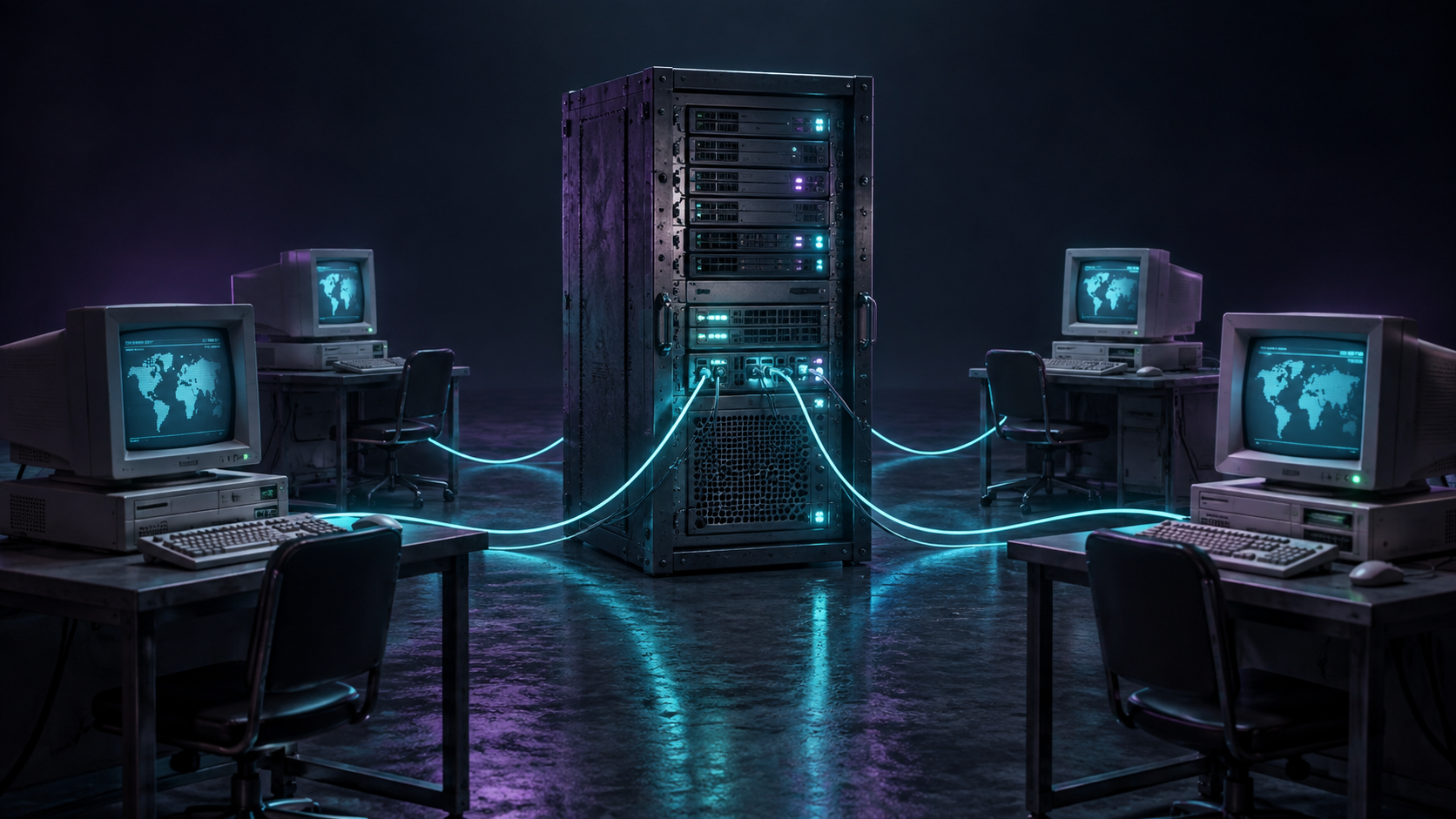
The phrase dedicated server appears constantly in multiplayer gaming.
For many players, it simply means a server that stays online even when the person hosting it leaves.
That description is not wrong, but it only captures a small part of what a dedicated server actually does.
At its core, a dedicated server is a game runtime whose primary job is not to play the game, but to coordinate it for everyone else.
Understanding that distinction becomes especially important when looking at classic online games, where the server software, networking model and supporting infrastructure may be decades old.
A game without a local player
In a traditional single-player game, most of the world exists inside one running copy of the game.
The same program handles the player, enemies, physics, scripted events, level state, damage and rendering.
Multiplayer changes that model.
Several computers now need to agree on what is happening in the same game world.
If every player’s computer were allowed to independently decide the truth, disagreements would appear almost immediately.
One machine might think a player is standing in one location while another thinks that player has already moved somewhere else.
One client could calculate a hit while another considers it a miss.
A dedicated server provides a central authority that helps resolve those disagreements.
In simplified form:
Player Clients → Dedicated Server ← Player Clients
The clients participate in the match.
The server decides what the match currently looks like.
The server is the authority
One of the most important responsibilities of many dedicated servers is maintaining the authoritative game state.
That can include information such as:
- which players are connected;
- player positions and movement;
- health and damage;
- score;
- teams;
- match timers;
- items and pickups;
- AI or other world entities;
- game mode rules;
- map state.
The exact responsibilities vary significantly between games.
Some older engines trust clients more than modern games would. Others perform much more validation on the server.
But the general idea remains the same:
someone needs to maintain the shared version of reality.
That role usually belongs to the server.
Clients send intentions
A useful way to think about multiplayer networking is that clients often send intentions, while the server distributes the resulting state.
For example, a client might communicate:
I moved forward.
I fired my weapon.
I activated this object.
The server processes that information according to the game’s rules and then communicates relevant results to other players.
Conceptually:
Input → Server Simulation → Updated State → Clients
Real implementations are much more complicated.
Games may use prediction, interpolation, snapshots, delta compression and many other techniques to make movement feel responsive despite network latency.
But underneath those techniques is still the problem of keeping multiple machines synchronized around the same match.
Dedicated does not mean master server
This distinction is particularly important when discussing older games.
A dedicated server and a master server are not the same thing.
The dedicated server runs an individual game session.
For example:
Server #1
Map: Arena
Players: 8 / 16

Server #2
Map: Compound
Players: 4 / 12
A master server, on the other hand, may simply help players discover those servers.
The relationship can look roughly like:
Dedicated Servers → Master Server → Server Browser → Players
If the master server disappears, the dedicated servers may continue functioning perfectly.
Players might still connect directly using an IP address.
What disappears is the mechanism that tells players where those servers are.
This is one reason classic multiplayer games can appear completely dead even when much of their networking functionality still works.
Dedicated servers do not need to render the game
Another major difference is presentation.
A normal game client needs to display:
- the 3D world;
- textures;
- lighting;
- HUD elements;
- menus;
- audio;
- animations and visual effects.
A true dedicated server often does not need most of that.
Its job is simulation and networking, not presentation.
That is why dedicated-server executables frequently run from a console window or command line.
Conceptually, they try to reduce the game to something closer to:
Game Rules
World State
Networking
Players
Simulation
        +
Administration
instead of:
Simulation
Networking
Rendering
Audio
HUD
Input
Presentation
Removing unnecessary presentation systems can reduce CPU, memory and GPU requirements and allow servers to run efficiently on machines without gaming hardware.
For older games, however, the separation is not always clean.
Some engines were designed with dedicated hosting from the beginning.
Others still initialize large portions of the normal game runtime even when they do not ultimately display anything.
That difference can become very important when attempting to recover or recreate dedicated-server functionality.
Listen servers are different
Another common multiplayer model is the listen server.
In this case, one player’s normal game also acts as the server.
That machine has two responsibilities:
PLAYER
  +
SERVER
This is convenient because no separate server software or machine is required.
A player starts a match, others join, and the host participates normally.
But it also introduces limitations.
If the host leaves, the match may end.
The host machine consumes resources both playing and serving.
The host may have a latency advantage.
And the availability of the server depends entirely on that player’s session.
A dedicated server removes the local player from the equation:
DEDICATED SERVER
       │
   ┌───┼───┐
   │   │   │
Client Client Client
It can continue running regardless of who joins or leaves.
That is one reason dedicated servers became so important for persistent multiplayer communities.
Administration is another major responsibility
Running a public game server requires more than simulation.
Dedicated-server software often exposes administrative features such as:
- changing maps;
- selecting game modes;
- setting player limits;
- configuring passwords;
- kicking or banning players;
- adjusting gameplay rules;
- writing logs;
- loading server configuration files;
- executing remote administration commands.
These features may seem secondary to the networking itself, but they are essential for operating a server continuously.
For communities keeping older games alive, administrative tools can become especially important because the original interfaces may be limited, poorly documented or dependent on software that no longer exists.
Why server software disappears
Dedicated-server software can become difficult to preserve for several reasons.
Sometimes it was distributed separately from the game client.
Sometimes downloads existed only on publisher websites that later disappeared.
Sometimes the executable depends on old libraries or operating systems.
And in some cases, a game technically contains much of the required server functionality but was never released with a practical standalone dedicated-server executable.
That last case is particularly interesting from a research perspective.
If the original engine already contains networking and multiplayer systems, the challenge may become understanding how much of the normal game runtime can be removed or bypassed while keeping the server simulation functional.
Questions quickly appear:
- Does the engine require a renderer to initialize?
- Does it assume a local player always exists?
- Can maps load without graphical assets?
- Which game systems are required for simulation?
- Which resources exist only for presentation?
- Can the runtime operate without sound or input devices?
These are exactly the kinds of questions that can turn an apparently simple idea—”run the game without graphics”—into a much deeper engineering problem.
Why dedicated servers matter for preservation
A multiplayer game may remain installable long after its official servers have disappeared.
But without practical server software, preserving the multiplayer experience becomes much more difficult.
Dedicated servers give communities something extremely valuable:
independence from the original operator.
If players can host their own servers, the game does not necessarily depend on the publisher keeping infrastructure online forever.
Community servers can migrate between machines, hosting providers and generations of hardware.
New administration tools can be developed.
Replacement master servers can help players discover them.
Compatibility patches can allow old server binaries to run on modern operating systems.
The original online ecosystem can gradually be replaced while the core gameplay experience remains recognizable.
The server is invisible, but essential
Players rarely spend much time thinking about the server when everything works correctly.
They launch the game, find a server and start playing.
Behind that simple interaction is a system continuously receiving information, maintaining state, enforcing rules and distributing updates to everyone connected.
A dedicated server may render no graphics.
It may produce nothing more visually impressive than console text and log files.
But for an online community, it can be one of the most important pieces of the entire game.
And decades after a game’s release, understanding how that piece works can be the difference between remembering a multiplayer experience and still being able to play it.